Published March 2026
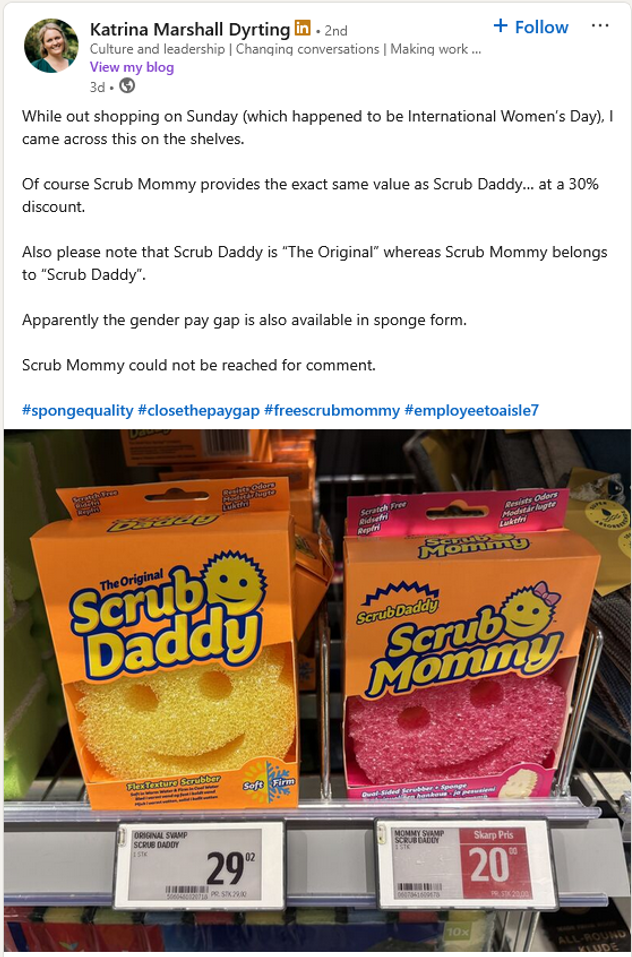
Katrina’s brilliant photo shows that we can’t help ourselves. Our anthropomorphizing brains nudge us to question Scrub Mommy’s pay gap. How can the pink absorbent foam pad be paid less even though she performs equal work as the yellow one?
This actually turns out to be an important question.
Should gendered sponges cost the same is similar to asking whether female football players should be remunerated equally as their male counterparts.
Gender Pay is a large and complex topic. One essential aspect that often gets overlooked is economics.
This doesn’t mean market outcomes are always fair — but understanding the economic mechanisms behind them helps us discuss solutions to Gender Pay Gaps more clearly.
In most economies, prices for goods as well as labour are determined by supply and demand (in the context of a competitive and regulated environment). This means for the Scrubs that their price reflects this principle.
Similar dynamics are reflected in football. Football players sell a product – it is not their ‘shot conversion rate’ or their ‘assists’. Ultimately, they sell entertainment. Not only does a falling tree make no sound when no one hears it, the perfect ball-control won’t make any money if no one sees it – and is willing to pay for this experience.
Women’s professional football generated €645m worldwide in 2024 (1). In contrast, the male-dominated European club football’s revenue was about €28.6bn in 2024 (2). In Women’s Football, Arsenal generated €25.6m (3) while in Men’s Football the male-dominated club of Real Madrid had revenues of €1.2bn (4).
In short, the more money is around, the more can possibly go around. This is also driven by market forces.
Other industries are subject to the same market principles. We wouldn’t necessarily be surprised if a male sales representative of Apple smartphones was compensated more highly than a female salesperson selling lower-revenue Sony smartphones.
Nonetheless, pay doesn’t need to be controlled by market forces. For example, in 2022 the US national soccer teams agreed to equal pay across genders (5).
Moreover, pay cannot be fully controlled by market forces. Equal pay legislation mandates pay free of discrimination. In practice, this usually applies
within companies instead of across companies (except for collective bargaining agreements). This shall ensure that e.g., salespeople within Apple receive equal pay for equal work but they do not
need to align to the pay to Sony’s sales staff.
_________________
Considering the insights above, an interesting thought experiment emerges:
how could equal pay across competing football clubs and gender be achieved?
Use the market forces to your advantage. If men and women were to play in mixed teams, they would sell the same product, share the same revenue pot, and operate within similar market forces. Pay then focuses on equal work – those players performing at equal levels should receive equal pay regardless of gender. I’ll leave the feasibility and desirability of mixed teams for the market to decide.
Using the market is also what the shop selling the Scrubs did. By changing the price of Scrub Mommy, they influenced the supply-demand dynamics. Homo economicus has considered the price and acted accordingly – Scrub Daddys are plentiful while Scrub Mommyies are a top seller with only one left on the shelf.
Sources:
1) https://www.statista.com/statistics/1607344/womens-pro-soccer-revenue-worldwide/
2) https://www.uefa.com/news-media/news/02a2-200452a66064-0cfd3f86b94f-1000--new-report-highlights-record-revenues-and-increasing-inv/
3) https://www.deloitte.com/uk/en/about/press-room/top-ranked-womens-football-clubs-generate-over-150-m-for-first-time.html
4) https://www.deloitte.com/uk/en/services/consulting-financial/analysis/deloitte-football-money-league.html
5) https://www.ussoccer.com/stories/2022/05/ussf-womens-and-mens-national-team-unions-agree-to-historic-collective-bargaining-agreements
I explore these questions in more detail in my book “The Equal Pay Guide – a practical framework for understanding, explaining, and managing Gender Pay, Equal Pay, Pay Equity & Pay Transparency”.
If you would like to conduct rigorous Gender Pay analyses and translate insights into impactful actions, you can find more information here - link to The Equal Pay Guide (available on multiple Amazon marketplaces)